

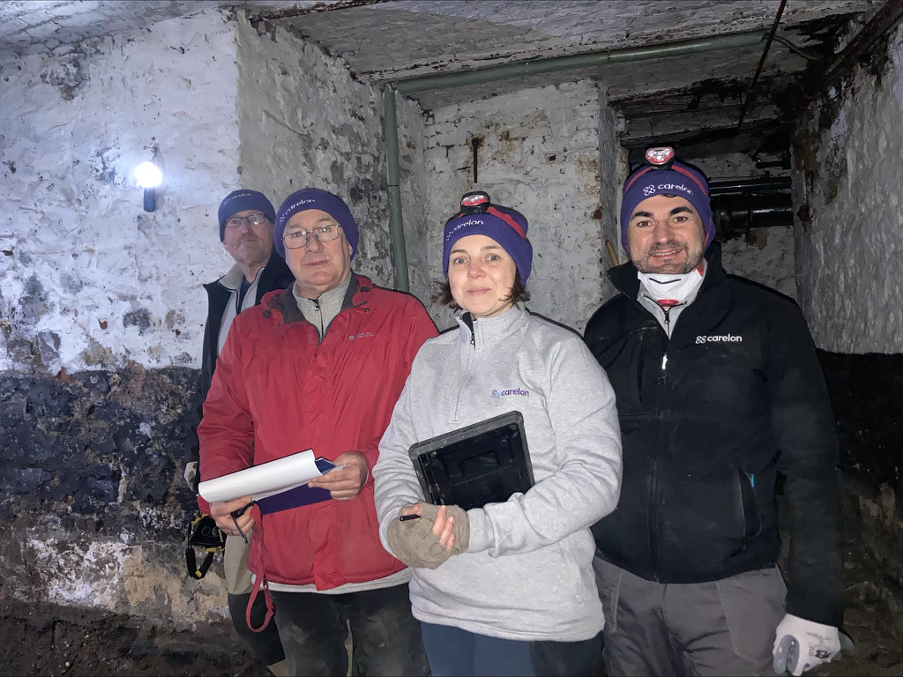
“I would be completely baffled if we don’t find him”, said Dr Loïc Guyon with a confident laugh.
Dr Loïc Guyon, the French consul for Limerick, has been at the head of an incredible project seeking to return the remains of a national hero to Ireland.
For the last 6 years, Loïc has served as the honorary consul of France for the Midwest region. His role involves being the representative of the French embassy in Clare, Tipperary and Limerick.
When he was first appointed in 2019, Loïc began looking into Limerick’s connections to France. He found a rich history of amicable interactions between Ireland and France: “They’ve always been very close; we had a common enemy, England.”
“We’ve always had very strong connections, even in the Middle Ages, when Irish monks would travel to France to study. There were a lot of trade links over the centuries; we have always been friends, historically speaking.”
He discovered an event known as ‘the Flight of the Wild Geese’. In 1691, a war in Ireland between supporters of King James II and King William of Orange ended with the signing of the ‘Treaty of Limerick’ upon the treaty stone.
“French soldiers were fighting alongside Irish soldiers against William of Orange’s armies.”
As part of the peace deal, the Irish soldiers, led by Patrick Sarsfield, were allowed to leave Ireland. Nearly 14,000 people left Limerick for France. These people became known as the ‘Wild Geese’. Many of the soldiers who left, including Sarsfield, joined the French army. Loïc saw this as a very important historical event between our two nations and believed it was worthy of celebration.
Thus, in 2019, the festival of the Wild Geese was launched in Limerick. Loïc’s event gathered nearly 1,000 people at King John’s Castle in celebration of Ireland and France’s historic friendship.
“After the 2nd edition of the festival, I kept seeing the name Patrick Sarsfield coming back up all the time.
“When you’re in Limerick, his name is everywhere, Sarsfield bridge, barracks, house, we are the only city in Ireland to have a statue of him.”
Sarsfield is said to have died in 1693 from wounds sustained during the Battle of Landen in Belgium.
“I said, ‘wait a minute, we have an Irish national hero who fought and died for France, yet nobody knows where he is buried?’ I thought, let’s try and find him, let’s bring him home.
“I decided to launch this project out of the blue. People at first were laughing, saying good luck with it.”
Loïc contacted the French Ministry of Defense and requested archival documents in relation to Sarsfield’s death. He discovered evidence that during the battle, Sarsfield was brought to the small town of Huy for treatment.
“I contacted the city council of Huy, and I asked them do they have any info whatsoever about a certain Patrick Sarsfield who might have died in Huy in 1693. It took a long time, but they sent me some historical documents. There was no proof he died in Huy, but there was mention of two anonymous French officers who died in August 1693, the same period as Sarsfield.”
He began a long arduous search through the Huy parish registers for any mention of Sarsfield; the documents written in Latin, French and Dutch yielded no results. He did, though, find mention of the two unidentified French officers who were buried inside a particular church in the town.
“I found the location of the church through Google Earth, but there was a house built where it once stood. I contacted the city council, and I asked ‘Who lives in that house?’
“They said we are in the process of purchasing the house for the city council. Once we have acquired the house, we would be delighted to give your team access to the site. It was a sign of destiny, perfect timing.”
He gathered a team of archaeologists and experts. The estimated cost of the excavation would be around €100k , it has turned out to be over €160k.
In 2023, Loïc launched the project’s fundraising campaign at the residence of the French ambassador in Dublin. “The fantastic thing is that we got all the funding plus more, now we are at €164,000. We currently have just about enough to complete the project.”
Excavations began in December 2023, and since then, many graves have been found inside and around the church.
“He was a major general, the third-highest rank in the French army. He would’ve been an important person, which could explain why he was buried inside the church.”
“It was total chaos in Huy at that time; there were 5,000 wounded soldiers, and Huy was where they were all sent. It’s not completely surprising, especially with a foreign name, that they wouldn’t have known who he was, but they knew he was a French officer. Perhaps the clerk who wrote the parish register didn’t get his name.”
“We know he had died precisely between the 7 and the 12; those two anonymous officers were buried on the 8 and the 12 of August, which means they died the day before. The 7 and 11 of August fit with Sarsfields’ purported death date.”
Five years later, Loïc and his team prepare for their final trips to Huy. They have DNA tested over a dozen remains, but have not been successful thus far.
They are currently digging in the spot cited in the parish records as the final resting place of the two anonymous officers.
In the meantime, Loïc has completed the monumental task of tracking Sarsfields Genealogy. He identified a living descendant in West Cork named Tim Sarsfield. Tim offered his DNA to the team, who are hoping to compare it to any remains found.
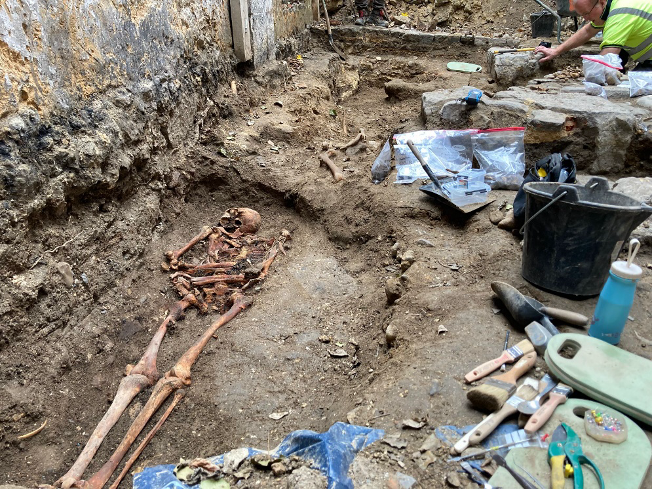
“If we have a match, which I’m confident we will, we will repatriate his remains on a French navy ship all the way from Belgium to Limerick. It would be appropriate since he died in the service of France. His remains would then be handed over to the Irish Defence Forces in Limerick and have a national funeral for him.”
Limerick locals have been doing restoration work on the Sarsfield statue ahead of his return.
Loïc spoke highly of all those involved with the statue restoration process, “People from Garryowen heard about the wild geese festival and thought it would be a great idea to refurbish the statue a little bit, which was rusted and covered in moss. They worked to improve the area around the statue; they did a deep clean, and the local youth organisations built flower beds.”
Loïc commended ‘The Gathering’ local boardgame shop owner, Gary Jackson, for being a “driving force behind the improvements around the statue.”
Dr Guyon and his team will travel to Huy for the final time in January 2026. They hope to have the last set of remains tested and identified by March.