

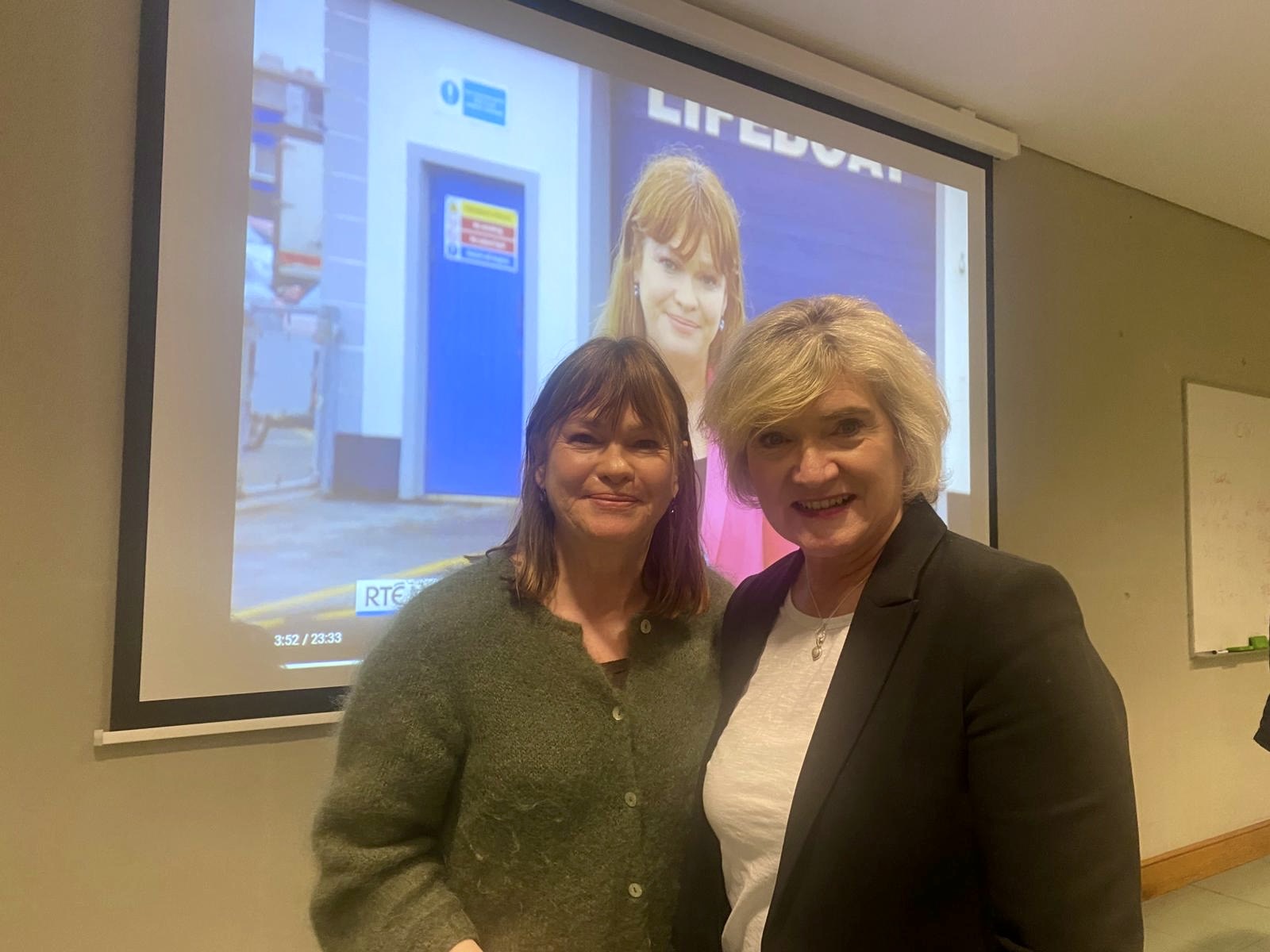
From fax machines to fast-moving digital feeds, the Irish broadcasting scene is constantly evolving. However, trust remains at the centre.
That was the central message delivered by esteemed RTÉ journalists Teresa Mannion and Cathy Halloran during an address to students at the University of Limerick, marking nearly a century of Ireland’s national broadcaster.
The two professionals have over 60 years of combined experience working for RTÉ, meaning they’ve had to adapt their skills over the years.
Cathy Halloran served as Midwest correspondent and journalist for 38 years with the esteemed Irish news outlet.
Teresa Mannion has been part of RTÉ since 2000 and has been regional reporter for the west since 2007.
Since its inception in 1926, RTÉ has played a defining role in shaping Irish society. As Halloran noted, “It’s worth celebrating, it has been a means of social change.”
When the organisation first came onto the scene it was a radio channel centred on Irish language and music.
Halloran stated the early days were there “to show independence of nation, independence of voice.”
The arrival of television on New Year’s Eve in 1961 marked a turning point, cementing RTÉ’s place at the heart of Irish life.
From there, it would go on to cover some of the country’s most pivotal and controversial moments, from the Contraceptive Train in 1971 to the lifting of the divorce ban in 1996.
“RTÉ was the only show in town, there was no internet. People lived for the Late Late Show on a Saturday night, which would often set the news agenda for the entire week ahead,” Mannion recalled, capturing its cultural significance.
“I grew up watching all these landmark events, all covered by RTÉ,” she added, reflecting on the broadcaster’s far-reaching influence.
Halloran emphasised that accessibility has always been central to RTÉ’s mission.
“It was available to everyone regardless of social status, this has remained at the heart of public service broadcasting even 100 years later,” she said.
That ethos helped establish RTÉ as one of the longest-serving broadcasting services in Europe.
Yet, while the mission has remained steady, the tools of journalism have transformed dramatically.
Mannion spoke candidly about the pace of change, “I worked in a time when we didn’t even have mobile phones, we had fax machines.”
The shift to video technology in the late 1980s and early 1990s revolutionised newsrooms.
Still, with speed comes risk.
“Technology is galloping ahead, more so than ever we need solid journalism,” Mannion warned. Both journalists returned repeatedly to the idea of trust as journalism’s most valuable currency.
“We need to tread carefully and still come back to the trust aspect of journalism,it’s a privilege to be a journalist,” she said.
Looking ahead, Mannion suggested traditional news formats may soon become obsolete.
“We’re still in a state of flux, maybe in five or ten years traditional bulletins will not be there at 1, 6 or 9pm,” she said, referencing a potential shift toward fully digital consumption by 2030.
Despite these uncertainties, the core purpose of journalism remains unchanged.
As RTÉ Director General Kevin Bakhurst said; “the need for strong, independent, and trusted public service media has never been greater.”
And for Mannion, the mission is simple: “What’s important is the truth and our own work, that what we see and hear represents the voices we speak to.”