

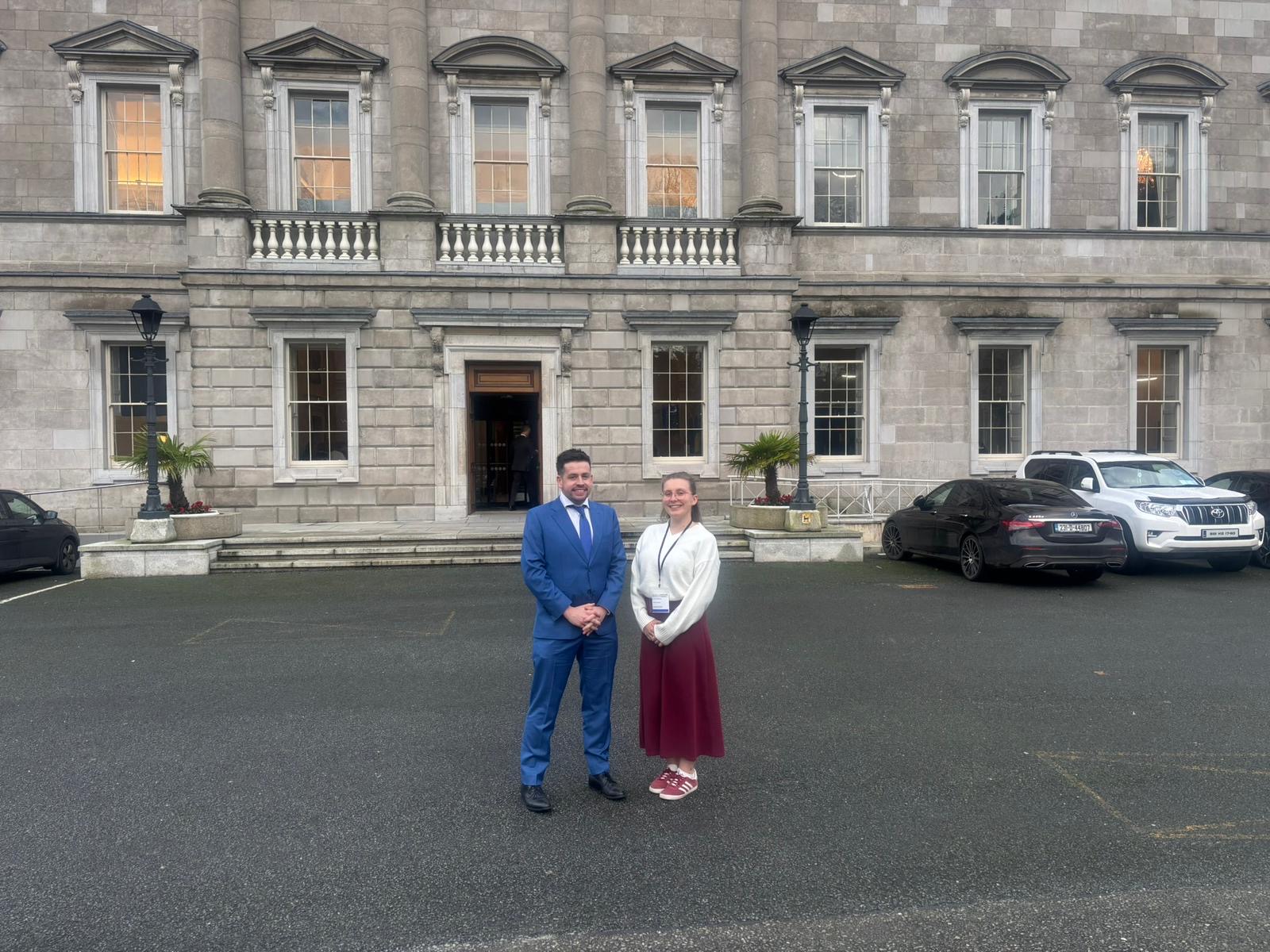
Just over a year after his nail-biting election win, Labour TD Conor Sheehan is still pinching himself. Limerick Voice chief news reporter Abigail Hayden spends the day with the first-time TD to see how he’s finding life in opposition and the long road from Limerick to Leinster House.
“I still pinch myself, if I’m being honest,” admits Labour Party TD Conor Sheehan, now in his second year in Dáil Éireann.
The 32-year-old reflects on the “honour” of sitting in the same parliament as renowned politicians, including the Limerick-reared Éamon De Valera, as we drive from Limerick city to Leinster House, a journey he now knows like the back of his hand.
The train is his preferred mode of transport for his weekly commute to the capital, but a last-minute radio interview on the Residential Tenancies Bill led to a change of plans.
No two weeks look the same for a TD, and sudden schedule changes are simply part of the job, something he now takes in his stride.
“It can be difficult at times to switch off,” he admits, “But look, I’m in a very privileged position… This is a job I wanted.”
First elected as a Limerick City North councillor in 2019, Deputy Sheehan claims he caught the “bug” instantly.
He was elected to Dáil Éireann in 2024 following an exceptionally tight race. At the tenth count, he trailed Social Democrats councillor Elisa O’Donovan by just one vote before ultimately pulling ahead.
He attributes his election success to the “energetic, positive campaign” he and his team ran, as well as the increased profile he gained during his mayoral bid.
I never really stopped canvassing. You have to believe you have a shot in politics because if you don’t believe you have a shot, why would you get up and get out of bed?
Casting his mind back to his early days as a TD, Deputy Sheehan recalls: “The first couple of days, I was quite nervous. I still am from time to time, but I was incredibly nervous. The first time I spoke in the Dáil, I thought I was going to faint.”
It’s a far cry from the cool, composed TD who now attends Leader’s Questions seated at the right hand of Labour Party leader, Ivana Bacik, before later delivering a 20-minute speech in the second stage of the Residential Tenancies Bill debate in his role as the party’s housing spokesperson.
The Limerick TD’s passion for his new role is evident in his every word, but he admits there are aspects of his former job that he misses: “When you’re a councillor, you’re closer to the people. And that is the difference.”
To bridge that gap, he fills his weeks with canvassing and constituency clinics – which he’s says are “busier than ever”, along with a wide range of local events.
I love when people come up to me, when they talk to me, when they come to me with an issue or a problem.
Deputy Sheehan believes the biggest challenge facing Limerick is “a microcosm of the biggest issue facing the country, which is housing.”
He also stresses the importance of ensuring Limerick receives the Garda resources and CCTV systems necessary for people to “feel safe in their community” alongside implementing the HIQA review recommendations for a new hospital in the Mid-West.
Being in opposition is another challenge of the role, which Deputy Sheehan describes as “incredibly frustrating.”
“In some ways people might say it’s easier because, when you’re in opposition, you’re not on the defensive, you’re on the offensive. So, you are critiquing, you are attacking. But I find it incredibly frustrating,” he explains.
“I spend my entire time going into the Dáil proposing amendments that the government vote down. So, you end up in a situation where you are saying an awful lot, but your ability to achieve change and to deliver is obviously stunted because you’re not in government.”
This is a clear distinction Deputy Sheehan draws between serving on the council and in the Dáil, describing the latter as “more adversarial.”
“Because of [the Dáil’s] nature, we have to respond, we have to critique, we have to attack. Sometimes they do the same. In the council, it’s less like that. The council is much smaller as well. It’s more low-key.”
When asked what he would consider a successful term, he says he hopes “to have served as an effective and efficient advocate for Limerick and the people I represent.”
Positioning the Labour Party so it is ready to enter government after the next election is also a key priority, he added, saying: “I want to serve in government. I want the opportunity to be able to deliver, hopefully as a minister for Limerick and the Mid-West.”
Reflecting on his performance so far, he says: “What I’m most proud of is being able to represent the people of the city that I live in, the city that I know. Being able to be a voice for young people, for people on issues like housing, for people who I feel don’t have a voice.
“As for how successful I am or how good I am, I think the electorate will give their verdict on that the next time out.”