

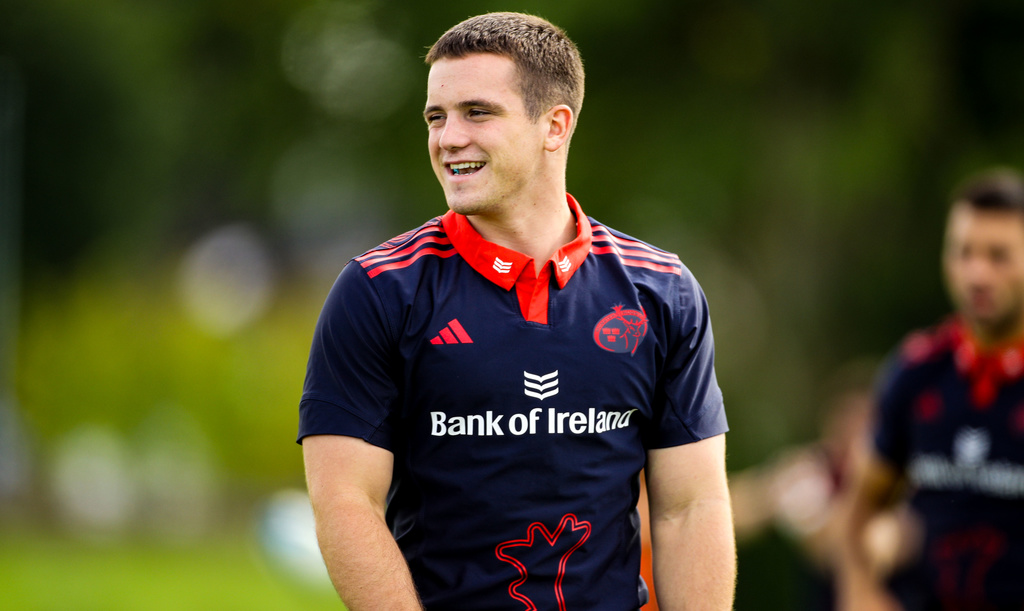
As Oisin Minogue approached the media room, Olivia Dean’s voice echoed from Munster’s gym, bouncing off the concrete walls and mixing with the low hum of post-training chatter.
It was an ordinary soundtrack to an ordinary training day, but it struck as a fitting backdrop to a player who seems so at ease with himself. In an environment where bravado often fills the gaps, Oisin’s openness about struggle and success feels refreshingly rare.
Growing up in Killaloe, rugby was not the dominant language. “Rugby really isn’t a big thing,” yet from an early age, the seeds were planted. A Munster flag hung above his bedroom door from the time he was two or three. The dream was clear long before the pathway was.
His childhood, however, was anything but single-minded. His parents threw him into everything – hurling, soccer, rugby, and tennis. That breadth, he believes, shaped him. There was no pressure to specialise too soon. Even coming from a well-known sporting family, he insists the push was never about performance. It was about enjoyment.
Still, he was aware of the weight of a surname. In underage setups, he recalls being introduced not by his own name, but as “Rosie Foley’s son.” He laughs about it now, but at 13 or 14, his parents had already prepared him. There would be pressure. It was inevitable. What mattered was how he carried it.
That emotional awareness is a thread running through everything he says.
When he made the decision to attend St Munchin’s College, it wasn’t easy. All his friends were staying put. It meant stepping outside his comfort zone into one of Munster’s most storied rugby nurseries. Looking back, he acknowledges how pivotal that choice was. It changed his trajectory.
Yet for all the milestones – captaining the Senior Cup side, earning Ireland Under-20 honours, he is quick to speak about the setbacks.
The most telling moment of our conversation comes when he discusses injury. A hyperextended knee shortly after entering Munster’s Academy left him sidelined for two months. For a young player trying to impress new coaches, it was brutal timing. Physically, he leaned into the gym, adding several kilos of muscle. Mentally, it was harder. “I struggled a bit, to be honest with you.”
There is no deflection, no sugar-coating. He sought out help from the performance psychologist in the building, “It released everything off my chest.” In a sport that still grapples with how openly players discuss mental health, his candour stands out.
On the pitch, he is meticulous. He studies plays alone before joining the dressing-room banter. He thrives on routine, left sock on first, caffeine gum before training, the same warm-up cues every matchday. He sets long-term goals, to play senior rugby for Munster and Ireland, but focuses obsessively on the small steps that lead there.
Off the pitch, he refuses to manufacture an image. In an era where athletes curate personal brands as carefully as game plans, Oisin shrugs at the notion. “If you like me, you like me, I’m just going to be myself.”
He also understands balance. When Ireland’s Under-20s were written off before a big win, he saw how quickly narratives shift. Media praise and criticism cannot be allowed to dictate emotional highs and lows. “You have to learn to get a balance between the good days and the bad days.” It’s a lesson he seems to be living in real time.
There is ambition, certainly. He speaks about modelling parts of his game on players around him and beyond, about chasing senior caps and pushing standards daily. But the defining quality is not hunger alone. It’s honesty.
If Oisin’s journey so far proves anything, it’s that his greatest strength may not be physical at all. It’s the self-awareness to confront pressure honestly and the resilience to grow through it – a quiet refusal to let setbacks rein him in.
And in modern rugby, that kind of toughness might matter most of all.