

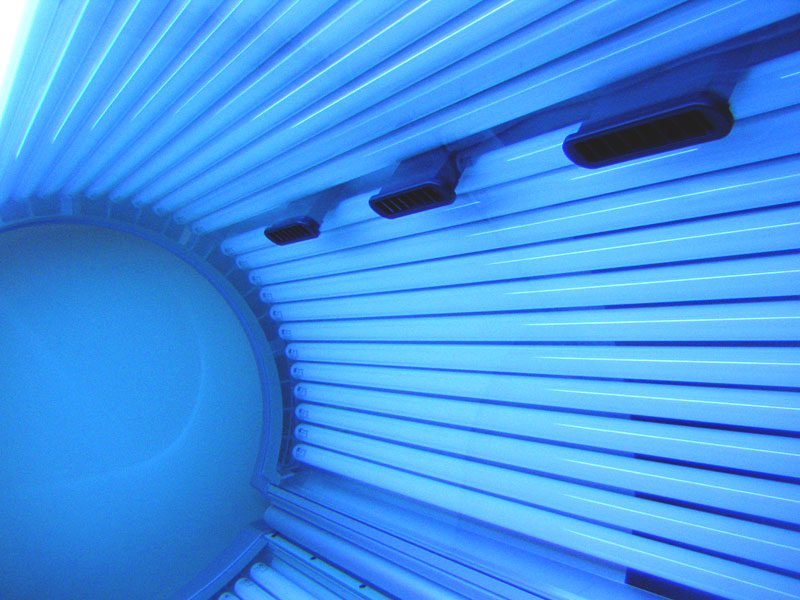
Skin cancer is Ireland’s most commonly diagnosed cancer, with over 11,000 new cases every year, according to the National Cancer Registry – a figure that continues to climb despite long-running awareness campaigns and Ireland’s grey skies. Behind that pursuit of year-round colour, sunbeds are quietly driving an epidemic that no SPF can stop.
Commissioned by the Department of Health, the HRB’s 2025 report, The Effectiveness of Public Health Interventions in Reducing Sunbed Use and Rates of Skin Cancer, examined 34 studies from around the world. Its goal was to determine how effective public education campaigns and regulations are in curbing sunbed use, a major contributor to skin cancer.
The findings are both revealing and cautionary. Educational programmes, from school workshops and social media campaigns to pamphlets and online tools, showed some success in lowering people’s intention to use sunbeds, but not their actual usage. Regulation-based interventions such as age limits and bans on unsupervised tanning produced similarly modest effects. Neither approach alone showed a significant drop in tanning behaviour.
What the evidence does suggest, the HRB concludes, is that a combined strategy linking education with strong regulation,offers the best chance of success. It’s the same model used for tobacco and alcohol control: pairing awareness with restrictions to change both habits and social norms.
Ireland is not alone in reassessing its sunbed policies. In July 2025, the Government announced it was considering an outright ban on sunbeds, citing international precedents and mounting public-health concerns. Minister for Health Stephen Donnelly said at the time that people who begin using sunbeds before age 30 increase their risk of developing melanoma by up to 75 percent. “We cannot continue to ignore the evidence.” he said, noting the parallels with Australia’s successful national ban.
Australia, once the world’s sunbed capital, introduced a nationwide prohibition in 2015 after years of evidence linking tanning devices to melanoma, a cancer responsible for most skin-cancer deaths. The move followed state-level bans that dramatically reduced tanning-salon numbers and coincided with falling melanoma rates in younger age groups. Public health experts now describe it as one of the country’s most effective cancer prevention policies.
Ireland’s situation is similar in scale if not geography. Despite public-awareness efforts like the HSE’s SunSmart campaign, the cultural appeal of tanning persists, particularly among young women. As the HRB review notes, education alone rarely shifts deep-rooted image norms. Social media influence and beauty standards continue to drive tanning behaviours even as people understand the risks.
Policies must be integrated, sustained, and supported by enforcement and cultural change.
The researchers point out that most sunbeds emit ultraviolet radiation (UVR) at levels equal to or higher than tropical midday sun. The International Agency for Research on Cancer (IARC) has classified sunbeds as Group 1 carcinogens, the same category as tobacco and asbestos. Even limited exposure, experts say, can cause DNA damage leading to both melanoma and non-melanoma skin cancers.
In Ireland, current legislation, the Public Health (Sunbeds) Act 2014, already bans use by under-18s, prohibits health claims by salons, and requires safety warnings and supervision. But the HRB’s findings and growing international momentum have led policymakers to question whether partial restrictions go far enough.
A national ban won’t come without controversy. The Sunbed Association of Ireland argues that professional salons operate safely under strict regulations and that an outright ban would push customers toward unregulated home devices or illegal imports. Supporters of the ban counter that the evidence is clear: no amount of UV exposure from a sunbed is safe, and the costs to the health system far outweigh any commercial benefits.
The HRB review supports that position, emphasising that the economic burden of treating UVR-related cancers is enormous – encompassing surgery, oncology care, and ongoing prevention efforts. International models suggest that effective regulation could save the Irish health system millions each year.
If Ireland follows Australia’s example, it will become only the second country in the world to fully outlaw sunbeds. Public health advocates say it would be a landmark move, one that sends a clear message that tanning is not harmless beauty care, but a proven carcinogenic activity.
For now, the HRB review gives policymakers the clearest evidence yet: education changes minds, regulation changes behaviour, and together they save lives. The challenge for Ireland will be to combine both in a way that protects public health while confronting the cultural obsession with the “healthy glow.”