

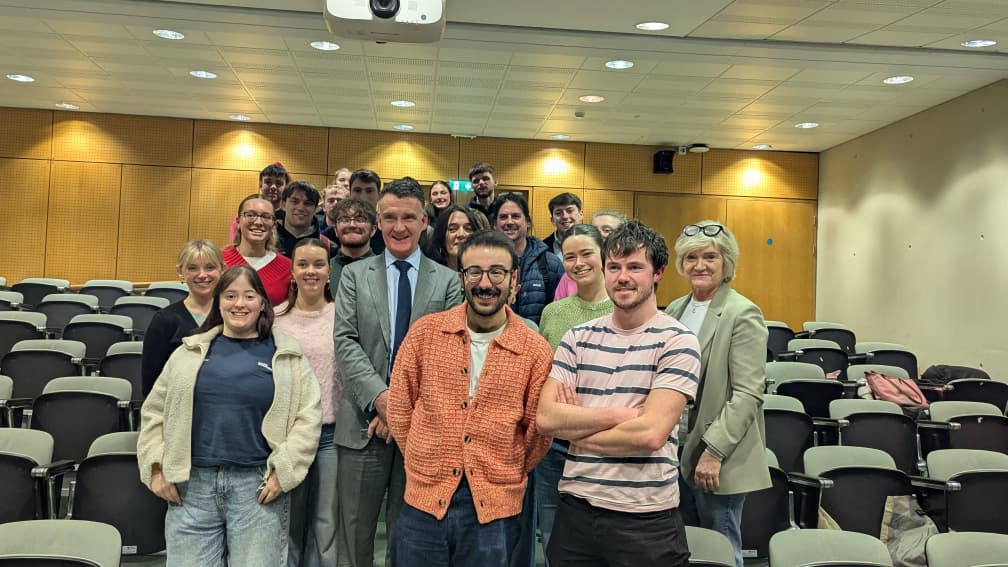
Trust, picking up the phone, and keeping personal opinions to yourself were among the pieces of advice that Mark Hennessy, Ireland and Britain Editor of The Irish Times, has for budding journalists starting out in their careers.
Mr. Hennessy spoke to University of Limerick students last week about what editors want and what democracy needs.
“Every time you get an opportunity to talk to people, do it,” he advised, adding: “People should want to tell you things.”
Mr. Hennessy urged students to “gain trust and honour that trust” when speaking with people and sharing their stories, emphasising the importance of “learning the art of listening”.
“You are carrying people’s stories in your hands,” he said.
He also focused onhow important it is for the public to support journalism, saying: “The public has a decision to make – it can live in a world of lies and rumour, or it can pay for journalism.”
His message to anyone skeptical of the media is simple: “If you think the press is bad, wait until you see what’s coming after us.”
Mr. Hennessy spoke to Limerick Voice reporters after the seminar about what he hoped students learned from his talk.
“I would hope that people would take away that journalism is an important trade,” he said. “A trade, not a profession.”
He also wanted students to understand that journalists are “important for Irish society,” adding that “any society that is trying to survive without a healthy functioning democracy will pay a very serious price if and when that healthy journalism disappears”.
While Mr. Hennessy feels we are “blessed” by the quality of reporting in Ireland on the most part, he acknowledged that “there are things we could do better” and indeed “things we shouldn’t do at all”.
“We’re by no means a perfect creature in any shape or form,” he said. “We never will be. But the alternative is a thousand times worse.”
“No society can operate on the basis of rumour and scaremongering. There has to be some version of facts that are checked, and that are accepted as being true, on which people can have their opinions.”
He continued: “If we don’t have that kind of commonality to a conversation, then we’re going to pay a very serious price in years to come.”
His advice to young people hoping to start out in the field of journalism is to remember “that journalism matters, that it matters more today than it ever has before”.
He believes that there is “a need for every journalist and budding journalist to keep their opinions to themselves,” adding that “all of us in journalism need to be more careful about what we do online”.
“The job is more and more about facts than it ever was before,” he explained.
To him, ensuring trust between the reporter and the people sharing their stories, and “treating those who talk to us with respect and decency,” is a vital aspect of journalism.
He said that journalists should be “absolutely motivated by trying to find out things and reporting those things accurately in ways that are important for society and in ways that powerful people in the society will not want to have reported.”
Mr. Hennessy also spoke about the Joe Drennan Memorial Competition for Inclusive Journalism, a contest for students across the island of Ireland encouraging a goal championed by the late Joe Drennan: to report on the underreported.
“Joe was a remarkable talent who was brutally taken from all of us so young. He would’ve had a remarkable career, and he was somebody who was already showing a large degree of evidence that he would’ve been somebody who would’ve poked his nose into all the places in society that are not poked into often enough,” Mr. Hennessy said.
“He would’ve been a voice for the voiceless.”
Mr. Hennessy added that it was his hope that, in the years to come, the Joe Drennan prize will be seen as being “the premier award for young journalists”.
“Any journalist who has it in their CV will be somebody who will find doors opening at a later point in their career,” he said. “It’s an important competition and everybody who has any interest in this trade should be trying to produce the best quality work that they can to apply for it.”