

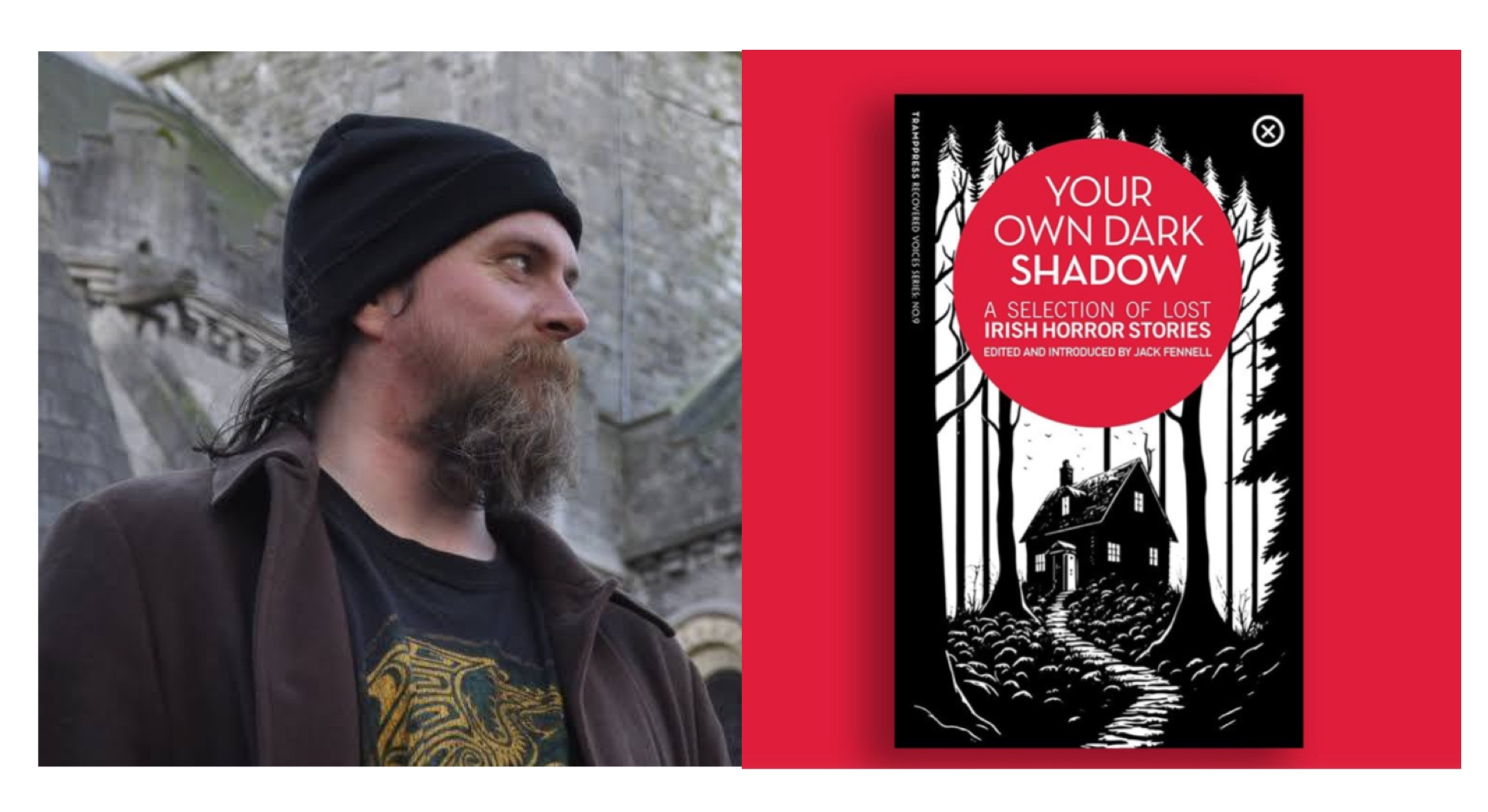
Monsters, mythology, and the entity of science fiction, acclaimed author Jack Fennell is an expert of these weird and wonderful genres.
His latest publication ‘Your Own Dark Shadow: A Selection of Lost Irish Horror Stories’ caught the attention of Dublin booksellers Hodges Figgis, winning their ‘Fiction Book of the Month’ award for October.
A proud Limerick native, his rural upbringing contributed to his love for Irish culture. Jack reminisces, “I loved any story at all, I was lucky that my parents were into it too. From the time I was very small there was always books about folklore and mythology in the house.
“As well as Irish tales, we had Australian Aboriginal stories from their time living abroad so I had a wide-ranging set of interests in literature as a kid.”
He jokingly admitted to never feeling ostracised from his school friends for his niche interests. “A lot of sci-fi in the 90’s had guns and action, so even though I might have been reading more cerebral stuff in my spare time, most of us lads were interested in ‘The Terminator’ and we could find common ground in that much.”
This interest grew over the years as Jack attended the University of Limerick (UL) and undertook a Bachelors in Language and Culture Studies, continuing to his Masters Degree in Monsters and the Grotesque. Excelling in his field, he chose to delve into Irish science fiction further- subsequently earning him a doctorate and a lecturing position in UL.
Jack explains: “Sci-fi is a genre that requires more of a buy-in. Stories can be set in a time when we can travel faster than light, or when robots are in charge. This definitely requires a suspension of disbelief. A lot of people don’t like that, it’s different strokes for different folks.”
He believes that people are reluctant to explore the world of non-fiction due to its lack of relevancy to real life.
“People look at things like ‘Star Trek’ and see aliens with stupid foreheads and see it as nonsense, but in so doing this they miss the fact that the reason these things are still popular is because it does actually address things that are still relevant to our society and culture. They just do it in an abstract form.”
Reflecting on modern science fiction such as British television series ‘Black Mirror’, the parallels to current societal issues are undeniable.
“Even now, we’re already seeing social credit systems being introduced in various countries around the world.
“Your online behaviour determines the kind of state support you’re going to get, which is sci-fi in a way” remarks Jack.
Apart from science fiction, Jack Fennell’s expertise lies in Irish mythology and folklore
The esteemed author praises the standard of Irish quest stories, believing this is a strong plot line many writers do best. One of his favourites, ‘The Tragedy of the Sons of Tuireann’ sees a band of brothers journey across Europe to acquire magical objects to appease the Sun-God, Lugh.
The publication of such stories was attributed to historical figures such as Lady Gregory and WB Yeats, who were collectors and preservers of Irish folklore in the early 20th century.
However, researchers like Jack go deeper to source the rarer stories. He explains, “A lot of them fell through the cracks, you have to go into things like the school’s folklore collection.
“You can see them all at duchas.ie In the 1930’s they got a bunch of school kids to ask their parents and grandparents for old stories that they remembered. It is full of notebooks they’ve scanned and published online, it’s amazing to read through.”
With the abundance of quirky content available here, he amusingly questions “were the kids just making this up?”
But Jack admits that many of these tales deserved to be collected at an earlier stage and shared with the public, noting that “some of them were part of a bigger story than what was well known at one time, but is not around anymore.
“Of course, a lot of this has to do with it being an oral culture. With the effects of the famine and emigration, if you don’t have people, then this oral culture just falls apart.”
An avid Gaeilgeoir, Jack Fennell is also a translator Irish stories into the English language
When asked about his translating process he says, “When finding the language for horror or fantasy stories, it’s straightforward. We have words for those concepts for thousands of years, you can look them up in a variety of dictionaries.
“But when the Irish started to write sci-fi in the early 20th century, they made up a lot of the words as they went along. You have to determine what they’re trying to say and then find a modern equivalent.”
How do scholars like Jack Fennell find these Gaelic stories?
“Majority of it is bibliographical research from the hardcore scholars of early modern Irish literature, for example people like Philip O’Leary. He has probably forgotten more about Irish literature than I will ever learn.
“Through these academics documenting the works they encounter, this literary world continues to expand. “Geeks like me come along afterwards and pick up on that” laughs Jack.
When tasked with the impossible question of naming his favourite Irish monster, he decided on the Fear Dearg (Red Man). A trickster character that lacks a moral compass, this menacing force is associated with the popular tale of changelings.
Advice for young writers
From his achievements in the realms of both publishing and academia, Jack Fennell is a highly regarded contributor to the Irish literary scene.
He advises any upcoming writers to be critical of their work. “If it’s not adding anything, get rid of it. Everything you put into a piece needs to be pulling its own weight.
“Now, if it’s contributing to the atmosphere of the story, or the psychological reading of the characters, leave it in. But if you think something is not advancing the plot, then you’ve got to chop it out.”
Jack also stresses the need for having a fallback, “Have a day job, writing is not something you can really support yourself on. Have a security that can sustain you.”
As a final note he urged authors to not write for a particular genre just because it has a large audience and will sell well. “You’ll burn yourself out. It would be a betrayal of your craft. Write the weird thing, write whatever you’re into.”