

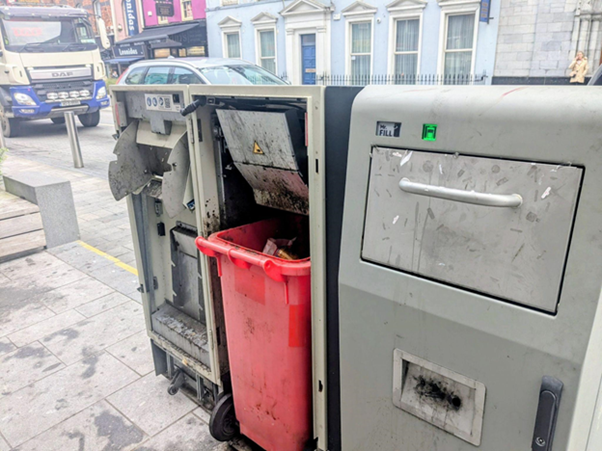
Limerick City and County Council has ramped up littering fines while investing in increased CCTV coverage across the city.
With Tidy Towns Adare launching a new anti-littering campaign, “Small Butt Deadly”, ahead of the Ryder Cup, Limerick Voice asked organisers and local representatives what they thought about Limerick’s litter problem and the current punitive strategy.
Helen O’Donnell, chair of Limerick Tidy Towns, said that a considerable contributor to waste issues in the city has nothing to do with individual litterers.
“You know, [there are] businesses that have no place to put their bins out on the street,” she said. “We come in on Sunday morning and the lanes are… strewn with litter, bins turned upside down.”
She said that while the fines “are grand” in principle, the city can’t ticket its way out of an infrastructure issue.
“Fines are grand. You know, you have to enforce these things, and we would’ve seen a lack of enforcement in the past,” she said.
However, O’Donnell argued that the emphasis on punishment can, at times, seem incoherent when the council is also pursuing what she views as overly complicated solutions.
“But for me, it’s bins that work. There’s no point. Frequently, we have bins in the city, pedal bins and they don’t work. You simply can’t put anything into them.” O’Donnell said she would prefer ‘bog standard’ bins rather than tech powered waste systems.
“You know how many basketball courts… how many paddle tennis courts you could have in a city for the amount of money it’s taking to keep the city clean?”
Ironically, Tidy Towns volunteers have themselves been on the receiving end of what O’Donnell described as an erroneous fine.
“One of our volunteers brought his bags and placed them by a bin in the city… Some very nice, kind citizens reported him. He got a fine and a notice.”
We put O’Donnell’s critique, centring on the gap between policy and reality, to Sean Golden, chief economist and director of policy at Limerick Chamber.
“But I think businesses can play a greater part as well,” Golden said. “In terms of how they can limit the footprint of their customers throughout the city centre.”
Golden said the issue often comes down to takeaway food and high-footfall streets.
“We’ve seen that a number of times on O’Connell Street, where people might get takeaway food, eat it outside, and then the grease ends up sticking.”
Golden also recognised that personal responsibility is a factor, citing a common bad habit: “Sometimes, you see a bin might be overflowing, and it might not be collected quickly enough. But people think it’s okay to kind of do Jenga with litter around the bin , and it’s obviously not okay.”
O’Donnell, referencing the deposit return scheme, pointed to a newer pressure point on the waste system. However, she said the problem isn’t those taking advantage of it.
“This has to be addressed… it has escalated since the return scheme because people are going through the bins for the contents,” she said, adding that she sees “very entrepreneurial people in the city” opening bins and taking out returnables.
“She’s one hundred per cent,” Golden said. “[People are] going into the bins and tearing them apart looking for cans and bottles.”
O’Donnell suggested a simple fix, drawing on examples from “other international cities, where you will see a bin with an area where you can place cans and bottles… and then someone can come along and take them,” she said.
While both interviewees want a cleaner Limerick, they diverge on what might be realistically achievable.
“Wouldn’t it be amazing to live in a city without plastic, where no vegetables are wrapped in plastic, where people could pick up vegetables and bring their own bags to the shop or supermarket?” she said. “The answer is not to use it to begin with.”
Golden, acknowledging that the ambition for greener supply chains is admirable, focused on practicality, saying it would “totally depend on cost, especially in the current environment. Um, because obviously businesses are being hit by increases across a number of areas energy, staffing, etc, and I suppose also what their customers want.”
He continued: “If this isn’t a request coming from their customers, then it’s not really going to be high on the list, particularly if it’s going to cost them additional money.”