

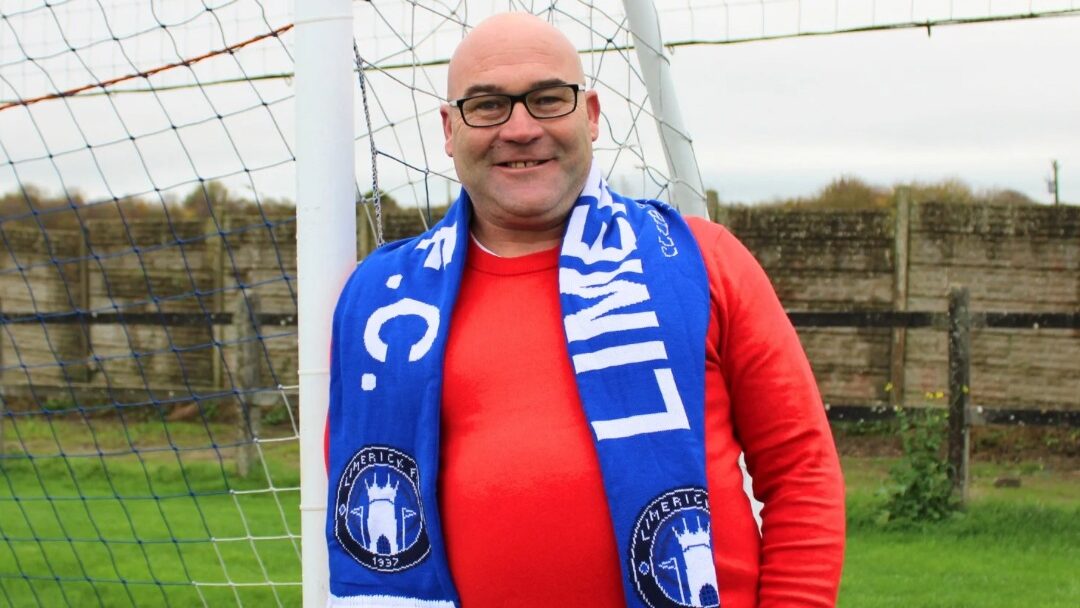
Limerick FC have revealed to Limerick Voice their long-term plans to fully return to League of Ireland football by 2037.
The project envisions a full boys and girls academy, men’s and women’s senior teams, and a 100% club-owned training facility, all of which newly appointed U15 coach Jason O’Connor promises “will compete at a high level”.
Plans for the revival began last July when junior side Carew Park FC assumed full responsibility for the day-to-day running of the club from long-serving CEO Pat McCormack.
“It originally came from meetings between Mark Heffernan and David Dineen,” O’Connor explained. “David has a proven track record in player development, while Mark and his family are Carew Park born and bred, with a huge affiliation to Limerick FC.”
Heffernan and Dineen’s scheme would reinstate the decades-old Blues last seen liquidated in 2019. Success would also mark the first time two League of Ireland teams have ever coexisted in Limerick.
Central to the plan is a strong developmental pathway linking grassroots football in Limerick with the League of Ireland, mirroring successful models long used elsewhere.
“When you look at clubs like St Kevin’s or St Joseph’s schoolboy teams, they’re closely linked with teams like Bohemians or Bray Wanderers,” he said. “Pipelines like that can kickstart development at a very young age – that’s the thinking behind this project.”
Carew Park’s track record is being pointed to as evidence that such a pathway can work.
“I went to Peterborough United from Carew Park. Willie Boland had a successful career in the Premier League with Coventry City after Carew Park. Jason Purcell went on to play professional football in Belgium via Carew Park. The proof is there.”
The club has already secured a full FAI academy licence covering age groups from U14 to U20 and confirmed their application to compete in the League of Ireland’s new proposed third tier.
“You can’t sit on your hands and hope for a merger,” he said. “We’re pushing forward with our own project.”
Infrastructure has been identified as one of the key lessons from previous incarnations of senior football in Limerick.
“Work has started on a full-size Astroturf pitch, with plans for a second,” he said. “Historically, the big issue for senior soccer in Limerick was the lack of training facilities. Clubs had to rent them, and financially that was not sustainable in the long run.”
Off the pitch, the club has prioritised fan involvement with decision-making, with supporters contributing online feedback to the club’s crest rebrand and discussions around potential fan-ownership models in similar vein to Cork City’s.
Even the club’s identity remains open for discussion, with a possible return to the “Limerick United” name, under which the city enjoyed its most successful era – not being ruled out.
While talks around a unified senior club in Limerick remain hypothetical, O’Connor admits the idea of Limerick FC and Treaty United pooling resources under one banner is the logical end goal.
“(Dineen and Heffernan) are wide open to that,” he said. “I’m just a coach, so I won’t be in those conversations, but if you want my opinion, that is 100% something I’d love to see.”