

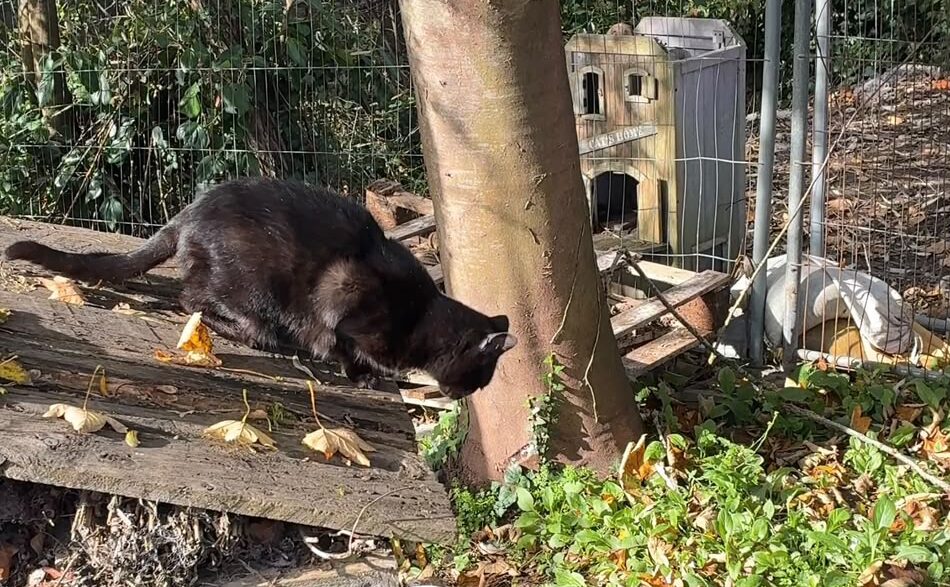
When the green disappears, who speaks for the cats of Adare?
IN ADARE, a wooded area that had long provided a home for a colony of feral cats has been paved over, raising concerns about what the change means for the cats and the volunteers who have cared for them over the years.
The issue was brought to public attention by Councillor Elisa O’Donovan, who expressed concern in a social media post.
She has since raised the matter with Limerick City and County Council, seeking clarification about the works and their implications for the colony.
View this post on Instagram
According to Cllr O’Donovan, the area was council-owned. The council moved the cats’ shelter a few metres to accommodate a rainwater-harvesting system being installed by Adare Tidy Towns. The fencing surrounding the area was also replaced for health and safety reasons.
While the council has confirmed that the shelters remain in place and that the new fencing allows access for both the cats and the volunteers feeding them, the issue extends beyond whether the cats can still reach their shelters. It concerns the environment in which they have lived and how this change will impact them.
Speaking to the Limerick Voice, Cllr O’Donovan said, “I would still like assurances about the suitability of the shelters, and whether the impact on the cats or any ecological assessment was considered before the works began.”
For animals that have come to depend on a particular space, even relatively small alterations can matter. Shelter, familiar surroundings, and safe access to feeding areas are the foundations of an animal’s survival.
Cllr O’Donovan believes, “Even seemingly small green areas can be important habitats. The council should consult with local volunteers and consider the ecological and animal welfare impacts before carrying out works such as these.”
The situation highlights a wider inconsistency between environmental commitments and the consideration given to decisions that affect local habitats.
“We talk a lot about biodiversity and protecting green spaces, but these commitments need to be reflected in decisions on the ground,” she said.
For the volunteers who have cared for the Adare cats for years and built a relationship on trust and care, the loss goes beyond a passing concern for their welfare.
Cllr O’Donovan urged, “I would like to see the council work directly with the volunteers who have cared for these cats for years to ensure they have proper shelter, safe access, and somewhere secure to live.”
She also hopes that some greenery can be restored wherever possible.
“These cats are part of the local community, and I think we should be supporting the people who care for them. How we treat vulnerable animals says a lot about us as a society,” she added.
To some, a small patch of woodland might seem insignificant against the scale of a town’s development. But to the animals that have called it home, it has been their world.
For a colony that cannot speak for itself, it depends on others to advocate for it. Hence, the responsibility falls to the community, the volunteers, and the public representatives who are willing to ask questions on its behalf.
Biodiversity is often discussed through the language of large-scale conservation, protected landscapes, and ambitious environmental targets. With the constant talk about preserving green spaces and building more sustainable communities, the world seems to be increasingly conscious of animal welfare and environmental protection. Yet the irony is that the everyday habitats that sustain wildlife are too easily overlooked.